
Beaufort County Criminal Docket Searches
Every Beaufort criminal docket search should begin at the statewide eCourts Portal. Its Smart Search pulls public criminal case information into a Register of Actions, which the Portal also labels a Case Summary. Got a court case number? Enter it exactly. Nothing separates a Beaufort matter from a same-named case elsewhere in North Carolina faster. With only a name, type it last name first. Set Location to Beaufort, and choose the Criminal case type only when that filter is dependable.
Know the Portal's limits, though. Per its own FAQ, the public cannot search cases by charge word there. So treat any match with care, checking location, type, status, and the entry chronology before trusting it as your case. Need a date instead of a history? Portal Search Hearings and the official civil and criminal calendars handle scheduling on separate tracks. When a public result is missing, restricted, or needs an official copy, the Clerk of Superior Court is the next stop.
- Open Portal Smart Search and use the exact court case number, if available.
- For a name search, enter the name in the supported order and set Location to Beaufort.
- Use the Criminal type filter only after the basic search, so a wrong filter does not hide a public result.
- Open the returned Case Summary and read its date-ordered Register of Actions entries.
- Use the Clerk of Superior Court for an official copy, certification, or a question about public access.
Note: A Portal search can help you locate a court case, but it will not tell you what a status entry means in your matter. That reading belongs with the official record and the court.
Beaufort Criminal Portal Filters
Filters help only when they match facts you already know. On the Portal, Beaufort is the right location selector. It is not Washington, Belhaven, Chocowinity, Aurora, or Washington Park. None of those towns runs its own criminal court. A case-number search usually beats a name search for precision, since spelling quirks, suffixes, and county routing can scramble a short results list.
The courthouse adds another research route. State court-record guidance says every clerk office keeps a public self-service terminal for criminal research. Search options include defendant name, case number, victim, witness. That terminal is not the Portal. Do not credit those wider search fields to the online tool. Confidentiality rules govern Beaufort County criminal records in either channel. For county-level context, the official criminal and infraction case activity report counts case categories moving through the courts, administrative figures rather than any live case.
The Judicial Branch activity report gives useful context on the case types that flow through the Beaufort criminal court docket. It cannot stand in for a single case's Register of Actions, which tracks one matter entry by entry.
Criminal Dockets: What They Show
A public Beaufort criminal Case Summary is a timeline of docket entries in order. It may list the case number, public parties, charge or case information where shown, hearing events, status labels, routing events, and entries tied to disposition. It is not the full court file. A case summary may appear online. That does not mean every warrant, indictment, plea paper, order, judgment, bond item, or financial document is downloadable.
| Case number | The court-assigned identifier. Use it as the most precise Portal and hearing-search key when known. |
|---|---|
| Case Summary | Portal’s public label for the Register of Actions, a chronological docket summary rather than a certified file. |
| Hearing entries | Public settings and events may appear. Confirm a near-term date through Search Hearings, the calendar, or the court. |
| Status | Labels such as Pending, Disposed, Completed, or Transferred to Superior Court describe a procedural state, not a full outcome. |
| Disposition-related entry | Read the dated chronology and official record before characterizing a plea, dismissal, sentence, appeal, or later proceeding. |
State records guidance draws a line between public summaries and official copies. A web printout helps you navigate. Only the Clerk of Superior Court can handle ordinary or certified copies of a Beaufort case record.
Beaufort Criminal Docket Status Labels
Read Portal status labels with care. Pending means the case is still open in that status context. It says nothing about why. It also says nothing about whether a hearing falls on a given day. Disposed or Completed tells you a procedural finish was recorded, but the word alone leaves the offense outcome, sentence, payment position, and any later collateral proceeding unstated. One line never tells the whole story; read the public chronology before concluding anything.
Transferred to Superior Court is a routing signal. It marks a Beaufort District Court criminal matter moving into the Superior Court route. Transfer to Another County explains why a Beaufort-only search may miss the active file. Voluntarily Dismissed with Leave is a specific label, not an acquittal or expunction. Appealed Appellate and Remanded mark appellate history. That history sits apart from the county case file itself.
- Register of Actions
- A date-ordered public summary of docket entries, also called a Case Summary in Portal.
- Continuance
- A postponed or rescheduled court event; the calendar alone does not establish that one was granted.
- Trial de novo
- A new trial route, relevant to certain District Court criminal appeals rather than a simple review of earlier evidence.
- Pending Expungement
- A procedural label that does not prove an expunction was granted or describe the final legal effect.
Note: A status word is just an index label. Case-specific questions belong with the official record and current court contact.
Criminal Case Stages on the Docket
A Beaufort criminal case moves through charging, arraignment-related process, pretrial settings, plea or trial activity, disposition, and sentencing. The docket entries come stage by stage. The sequence matters more than any single label. Later entries can change what an earlier setting, transfer, appeal, or disposition notation meant. For a future court date, check against the current case division and date range.
Docket flow: Charge Filed → Arraignment → Pretrial Settings → Plea or Trial → Disposition → Sentencing
A case can have two paths that do not match. One is the record path. The other is the hearing path. Portal Search Hearings asks for a Beaufort location and a supported search type. It also needs specific date controls. The criminal calendar takes a wider view of the whole session. A court notice or a later order can still move a setting after either tool is checked. So confirm any imminent appearance with the court itself. Do not trust an older result.
Beaufort Criminal Court Transfers
Beaufort County sits inside North Carolina's unified General Court of Justice. District Court takes misdemeanors, traffic matters, infractions, and other District criminal cases. Felonies and Superior criminal matters belong to Superior Court. Both divisions show public case information in the statewide system. The unified local Clerk keeps the county file. That structure matters for reading results. Check the court division and status first, before assuming a case vanished.
A District Court criminal appeal, for instance, moves up to Superior Court for trial de novo. So a Superior Court entry may simply follow a District Court path. It does not open an unrelated second case. Appeals travel a separate route. The North Carolina Court of Appeals comes first, then the Supreme Court of North Carolina. Appellate history, though, never substitutes for the Beaufort trial-level Register of Actions.
| Beaufort criminal route | Typical public docket task | Official record route |
|---|---|---|
| District Court | Check misdemeanor, traffic, infraction, or District criminal case information in Portal and calendars. | Clerk of Superior Court |
| Superior Court | Check felony and Superior criminal case information in Portal and calendars. | Clerk of Superior Court |
| Magistrate process | Recognize magistrates as District Court officers, not a separate city court. | Clerk and court channels as applicable |
Beaufort County Criminal Docket Courts
The Beaufort County courthouse at 112 W. Second Street in Washington hosts Superior Court, District Court, magistrate, Clerk, and related court offices. The Superior Judge office answers at (252) 940-4016. The District Judges office is listed at (252) 940-4012. These offices and the Clerk serve a statewide court system, not municipal criminal dockets. A criminal matter from any Beaufort municipality follows the county route its case identifies. That route runs through District Court or Superior Court.
Clerk of Superior Court
112 W. Second Street
Washington, NC 27889
Mail: P.O. Box 1403, Washington, NC 27889
(252) 940-4000
The Clerk is the local custodian for official criminal case files, public-terminal access, copies, certifications, and CR-314 requests.
For official numbers, use the Beaufort County court contact directory. The District Attorney runs a separate prosecution office and does not hold the Clerk's court record.
Beaufort Certified Criminal Searches
A public Portal printout and a clerk-certified county search do different jobs. The AOC-CR-314 certified criminal record search form lets a requester ask for criminal cases, infractions, or both in one chosen county. Its clerk section logs the period searched. It can support a no-record result or attached excerpts with a page count, signature, date, and raised seal. The published fee for the criminal record search is $25.
Know the form's limits. It covers one county, not the whole state. Names can be indexed imperfectly. Electronic infraction records may be purged five years after disposition. Juvenile records are not furnished. When requesting an official copy, name the exact document or certification wanted. Then ask the Clerk about cost and delivery before paying.
The qualifying-nonviolent-offense expunction statute sets one statutory path. It is not a universal eligibility test for every situation.
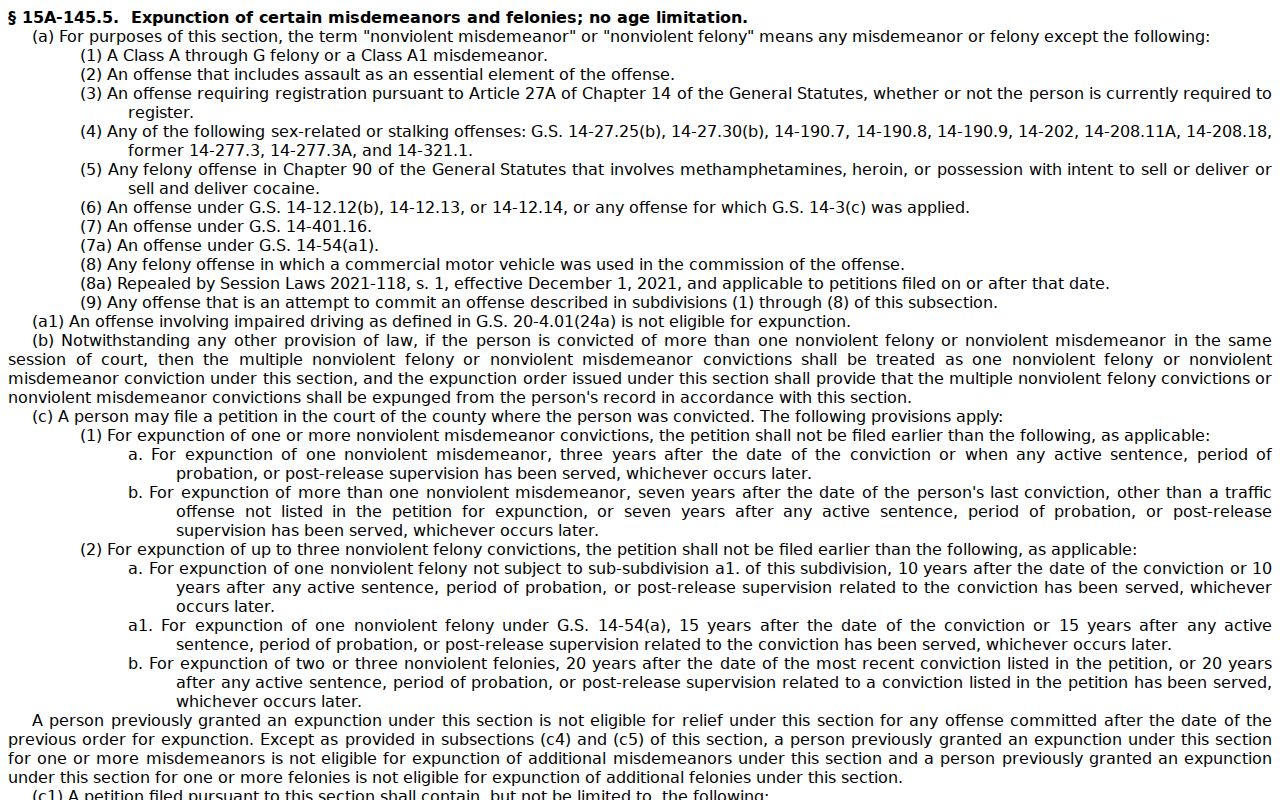
That statute draws a careful line. It governs an expunction process; it does not mean any specific criminal docket entry has disappeared.
Access Rules for Criminal Dockets
Public access in North Carolina starts with G.S. 7A-109. That law requires clerks to keep the listed court records, files, dockets, indexes, minutes, and judgments, and to open them for public inspection unless another law bars access. G.S. 132-1 states the state public-record policy. Neither rule puts every criminal record online. Neither overrides a sealing order, confidentiality law, or court restriction.
Sealed matters stay out of ordinary Portal access. Juvenile files are not ordinary public criminal docket material; G.S. 7B-3000 limits who may inspect juvenile records. Unreturned warrants and other restricted categories can face similar limits. A missing result might mean a search error, no public match, a county transfer, or a lawful restriction. It proves nothing about non-public facts.
Public-record boundary. Portal’s Register of Actions is a public summary, not the official file. The Clerk supplies the lawful copy route; sealed, juvenile, expunged, and otherwise restricted information remains outside ordinary public search.
The juvenile-record confidentiality statute sets an access boundary that ordinary Portal searching cannot remove.
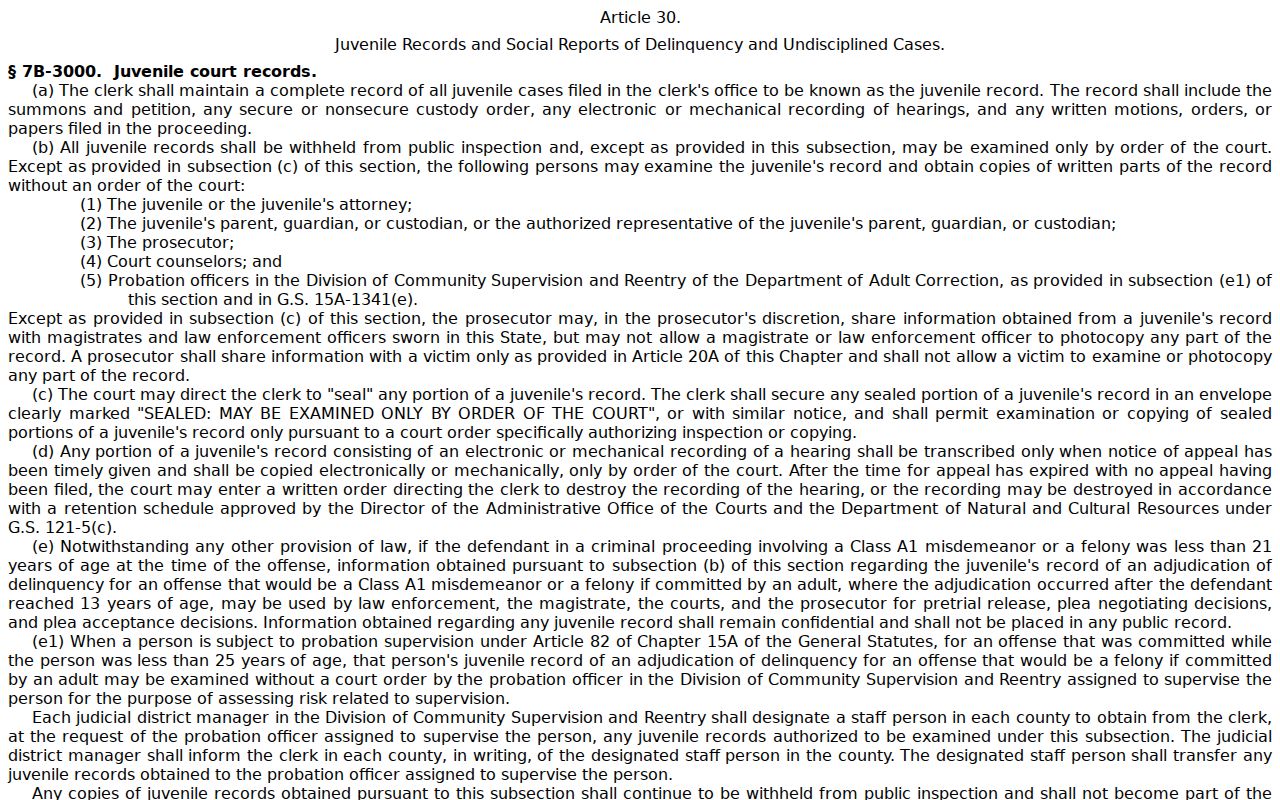
That source drives the point home. A general criminal docket search must never be used to infer or expose restricted youth records.
Beaufort Criminal Docket Gaps
When a Beaufort criminal search returns no public result, check the supported fields first. Do not broaden the claim yet. Confirm the spelling and name order. Use the exact case number if you have it. Verify that Location = Beaufort, and drop any type or status filter that may be wrong. A transferred case may now sit in another county or in Superior Court. For a listed hearing, use the current date range in Search Hearings rather than leaning only on the case summary.
Then try the local records route. The Clerk's public terminal may permit a different search method. The Clerk can explain how to get an official public copy. Court reporters and digital-recording procedures sit apart from the docket-summary route. District Court criminal proceedings are generally not recorded, subject to a stated exception for certain Class H or I felony pleas. So an absent transcript is not necessarily a failed search.
Note: Court staff can confirm records channels and current settings. They cannot give legal advice or say what a case entry legally means.
The official expunction information is the right starting point. It fits when a person needs the current filing route rather than a Portal interpretation.
The Clerk of Court handles expunction paperwork, and Judicial Branch guidance walks through that process. Searching Beaufort County court docket entries is one thing; getting advice on clearing a record is another, and the two stay separate.