
Beaufort County Civil Docket Searches
Begin any Beaufort County civil docket search in the eCourts Portal. Its Smart Search tool pulls up public civil case information and a Case Summary. The Case Summary is simply the Portal's name for the Register of Actions. An exact case number works best. If all you have is a name, set Location = Beaufort before adding other filters. That step matters. The General Court of Justice spans the whole state. A name-only search can drag in cases from other counties.
Choose case types with care, too. Beaufort civil pathways include Civil General, Civil Magistrate, Summary Ejectment, Civil Foreclosure, Decedents Estate, Guardianship, and Special Proceeding. Pick the wrong one and a matching case may vanish from results. Skip the status filter unless you truly need it. The Portal applies many status and routing labels to civil matters. Read any public Case Summary as a timeline. Take copy requests and access questions to the Clerk of Superior Court.
- Enter the exact case number in Smart Search when it is available.
- For a name search, set the Portal Location to Beaufort before adding other filters.
- Choose a case type only when the category is supported by the record or notice.
- Review the public Register of Actions in date order, including status and hearing entries.
- Ask the Clerk about a particular document, certification, or access limit.
Note: A public Case Summary can help you locate a civil matter, but it cannot tell you what a claim, order, or procedural label actually means in law.
Beaufort Civil Portal Filters
The Portal's detailed categories exist for a reason. Not every Beaufort matter is an ordinary civil lawsuit. Civil General may travel a different court route than Civil Magistrate. Estates, guardianship, incompetency, foreclosure, and special proceedings can pull in the Clerk's statutory functions. A category name helps you spot which branch of the court system a public result belongs to. It decides nothing about the merits. It guarantees nothing about which documents are public. It does not create a separate Beaufort probate court.
Search broad at first. False absence is a real risk when filters narrow too quickly. Confirm the case number or name and the Beaufort location, then add a credible case type. Only then weigh a status label against the public chronology. For a case-specific question, turn to the current Portal interface, the local Clerk, and court notice. Each beats a guess about an old entry. The Judicial Branch court-officials overview lays out the clerk and magistrate roles that shape these different docket routes.
That official overview pairs well with a Beaufort civil docket search because it separates the Clerk of Superior Court and magistrates from the state's distinct civil tribunals.
Civil Dockets: What They Show
A public Beaufort civil Register of Actions is a dated public summary. It tracks a case's progress. The Case Summary can show case association, chronology, status, and hearing navigation where public. It does not mean everything is open to anyone. Not every complaint, answer, motion, exhibit, order, estate paper, or foreclosure document is downloadable by the public. The Clerk holds the official county file. Family and protected-person information carries extra limits.
| Case number | The court-assigned identifier and the strongest public search key when known. |
|---|---|
| Case category | A public type such as Civil General, Civil Magistrate, Civil Foreclosure, estate, guardianship, or Special Proceeding. |
| Register of Actions | The dated Case Summary chronology. It is a public docket summary, not an authenticated full file. |
| Status label | A procedural marker such as Pending, Stayed, Reopened, dismissed, appeal, transfer, or final judgment. |
| Hearing information | Public setting details where returned. Confirm a close date through Search Hearings, the civil calendar, or the Clerk. |
Be precise when asking the Clerk for something. A reader might want a docket summary, a copy of a public order, a certificate under seal, or a judgment transcript. Each request has its own access and fee considerations.
Beaufort Civil Docket Categories
Beaufort civil dockets span several court and clerk pathways rather than one generic civil docket. Superior Court is the general civil route for claims above $25,000. District Court handles civil matters in its range plus domestic cases. Small claims, possession and property categories, and summary ejectment go to magistrates. Magistrates serve as District Court officers. Estates, guardianship, incompetency, foreclosures, and special proceedings can involve the Clerk's statutory jurisdiction. The unified state court system ties these routes together. Still, they should not be flattened into one.
| Portal or court category | Usual Beaufort context | Public-record caution |
|---|---|---|
| Civil General | Superior Court or District Court civil route, depending on the matter. | Use Portal and Clerk; a category does not decide jurisdiction in a live case. |
| Civil Magistrate / Summary Ejectment | Magistrate as a District Court officer. | Confirm current local filing limits and procedures with the Clerk. |
| Estate / Special Proceeding / Guardianship | Clerk-side statutory jurisdiction. | Protected-person and estate material can have different public boundaries. |
| Civil Foreclosure | Clerk and statutory special-proceeding process. | Do not recast it as Civil General solely because property is involved. |
Statewide materials say magistrates may handle small claims, and the same help warns that local limits vary. So the sound Beaufort instruction is simple. Call the Clerk for current local small-claims limits and filing requirements rather than trusting a fixed amount.
Beaufort Civil Docket Status Labels
Civil status labels describe procedural conditions, nothing more. Pending means the matter has not reached a final completion state in the selected system context. Stayed signals a procedural pause. Reopened means a case is active again. Dismissal variants, final judgment labels, appeal, small-claims appeal, trial de novo, transfer to Superior Court, and transfer to another county must be read against the dated sequence. None stands alone as an explanation of the case.
Two labels deserve special care. In a small-claims appeal, trial de novo means a fresh trial, not a quick review of the earlier evidence. A clerk disposition is a docket term, not a conclusion about anyone's conduct or rights. The Portal status menu works well for narrowing a known case. It is no basis for telling a case's full story without the public record itself.
- Stayed
- A procedural pause. The label does not disclose why the pause occurred.
- Reopened
- A return to an active procedural state, not a statement about the merits.
- Special proceeding
- A statutory proceeding that may be handled by the Clerk rather than ordinary civil trial process.
- Trial de novo
- A new trial route that can arise in the small-claims appeal path.
What Cases Fill the Civil Docket
Beaufort County civil dockets cover a lot of ground. Contract disputes lead the list. Tort, property, small claims, foreclosure, estate, and special-proceeding matters all appear, along with domestic categories where public access is permitted. A public category is a routing aid. It is not a license to publish sensitive information. Family, adoption, guardianship, incompetency, juvenile-adjacent, and protective matters can include confidential or limited material, so treat any online result with a privacy-first approach.
Small claims has its own local path. You file through the Clerk in the proper county, and a magistrate decides the claim. State court information lists money claims, repossession of personal property, and summary ejectment among small-claims matters. An appeal sends the case to District Court. The trial-de-novo label there explains later public docket entries. The active case record stays countywide, not city-run.
One caution applies. A civil category can identify a court route, but it cannot reveal private facts or the final outcome of a case.
Beaufort Clerk-Side Civil Dockets
The Clerk of Superior Court does far more than take filings. In Beaufort, this unified clerk keeps the records for Superior and District civil files. Clerk-side records also cover estates, special proceedings, guardianship, incompetency, and related matters. State records guidance adds civil, special, and estate searches at the clerk-office public terminal. Use the actual category when you search. There is no separate probate court. There is no local probate database to invent.
Clerk of Superior Court
112 W. Second Street
Washington, NC 27889
Mail: P.O. Box 1403, Washington, NC 27889
(252) 940-4000
Use the Clerk for public-terminal research, official county files, copies, certifications, estates, and special-proceeding record questions.
Need the official local court gateway? The Beaufort County Judicial Branch page fills that role, and no city office hands out copies of the Beaufort state-court case file.
Hearings on the Civil Docket
Civil settings appear in two places. Portal Search Hearings is one. The other is the official county-calendar route: at the North Carolina calendar selector, set County = Beaufort and Calendar Type = Civil. Portal Search Hearings works better case by case. Select Beaufort, choose a supported search mode, and enter its required date controls. A case number helps when known; documented modes also include party, business, attorney, judicial officer, or courtroom information with a date range.
A calendar is not the final instruction to appear. Treat it as a lead. The Judicial Branch warns that counties may not post or update calendars, and court notices, continuances, weather closures, administrative rescheduling, or case orders can change any setting. Beaufort's local materials list civil status and continuance items. It proves no universal deadline or guaranteed remote option. For a near-term, missing, or changed date, contact the Clerk or the relevant court office.
For county-level administrative context on the civil docket, the official Civil Overall Caseload Activity Report publishes the figures.
That report describes system-wide caseload activity. For one case's next setting, a current Portal hearing result or confirmation from the Clerk is the route.
Beaufort Civil Record Copies
Portal searching costs nothing for ordinary public use. A Portal printout is another matter. It is neither a certified record nor necessarily a complete file. For a paper or official copy, describe the public document you want and ask the Clerk about access, cost, and delivery. The January 2026 statewide miscellaneous-cost chart sets the prices. The first page of each document runs $2.00. Each additional page or fraction costs $0.25. A certificate under seal is $3.00. The chart also lists exemplification at $10.00 and a transcript of judgment at $10.00.
Those are chart amounts only. They promise neither that every civil record is available nor that every request costs the same. Document grouping, page count, access limits, and the exact type of authentication all shape a request. Beaufort sets no countywide processing-time promise, general identification rule, or all-purpose civil-record-copy form, so ask the Clerk for current instructions before sending payment.
For official court activity reporting, turn to the Judicial Branch data and statistics page. It does not provide private case-file copies.
It covers court-system reporting, not the Clerk's civil records.
Who Can See Civil Dockets
G.S. 7A-109 puts clerks in charge of listed records, files, dockets, indexes, minutes, and judgments. Unless law blocks access, they must be open for public inspection during regular office hours. G.S. 132-1 states North Carolina's public-record policy. The practical Beaufort rule is narrower. "Everything is online" overstates it. Public information may be searchable online, but the Clerk controls official local records, and restricted material stays restricted.
Sealed documents never appear in ordinary Portal access. Domestic, guardianship, incompetency, adoption, juvenile, and protective information can carry statutory or court-ordered limits. A missing public result has many causes. It can stem from an incorrect search, no matching record, a transfer, or a lawful restriction. Do not infer non-public facts from it. With a public file question, use the Clerk's lawful access route rather than trying to bypass a Portal limit.
Public access boundary. The Register of Actions is a public chronology where available. It is not a complete official civil file, and a public case category does not make protected information available.
The public-records statute is the official source image lead for this access rule.
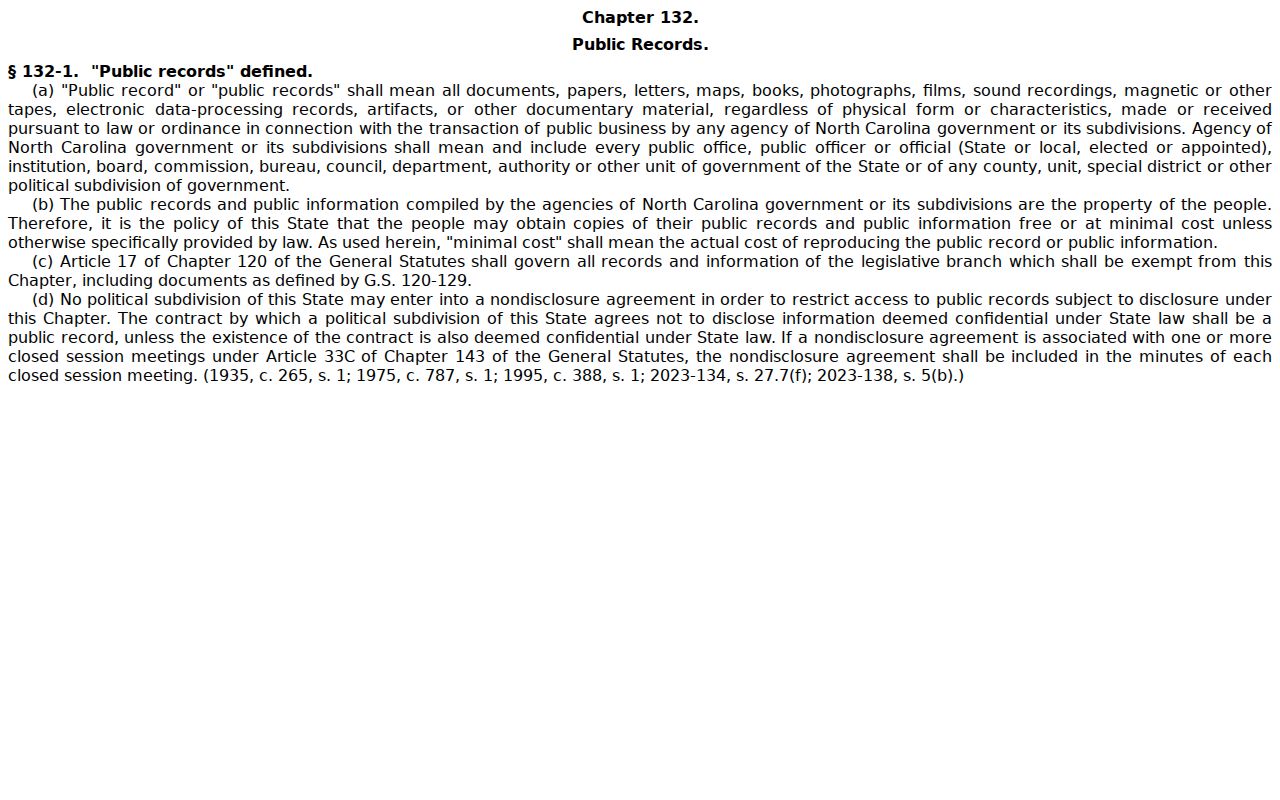
The statutes back public access. They also preserve the confidentiality and court-order boundaries that apply to some Beaufort civil files.